









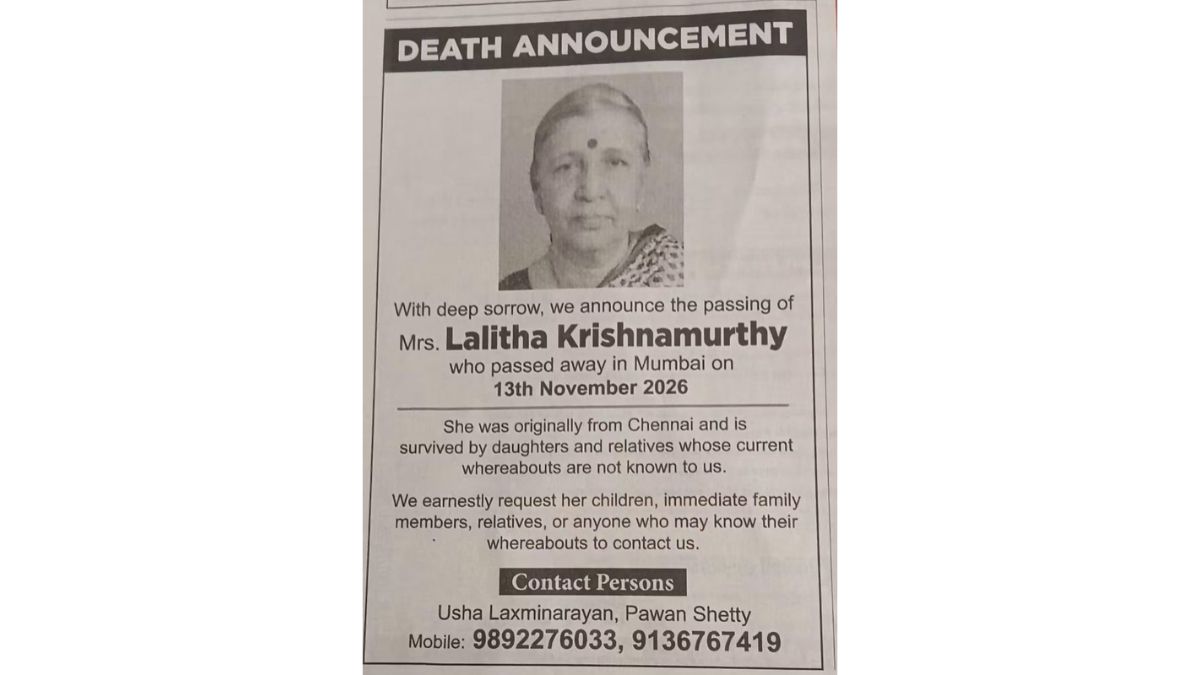
Lalitha Krishnamurthy, Who Lived Alone For 40 Years, Dies; Residents Handle Last Rites
Mumbai, 19th November 2026: Lalitha Krishnamurthy, a woman who had reportedly been living alone for nearly 40 years, has died, with residents of her building stepping in to complete the necessary formalities after no immediate family members came forward.
A death notice circulated in Chennai, seeking information about Lalitha’s daughters, listed Usha Laxminarayan and Pawan Shetty as contacts. Following its circulation, the two revealed that Lalitha had lived by herself for four decades and that her cousins had looked after her only during the final days of her life.
With no immediate blood relatives coming forward following her death, building residents took responsibility for completing the necessary formalities. The notice subsequently gained attention across Mumbai and beyond, prompting discussions around the social isolation experienced by elderly people living alone.
A qualitative evidence synthesis published in the Indian Journal of Medical Research (IJMR), titled ‘Social Isolation and Loneliness Among Older Persons in India’, examined 21 studies to understand the experiences of social isolation among India’s elderly population.
The research identified migration of children to urban areas and abroad, the growing prevalence of nuclear families, intergenerational conflicts and the loss of family members as factors contributing to loneliness among older people.
The study also cited findings from the Longitudinal Ageing Study in India (LASI), which recorded a loneliness prevalence of 14.9% among older persons. Another population-based survey, the World Health Organization’s Study on Global Ageing and Adult Health (SAGE), recorded a prevalence of 20.4%.
The research further highlighted how physical ailments and limited opportunities for social interaction can deepen isolation, while neighbourhood networks, community activities and regular contact with family members can help reduce it.
Lalitha’s death has brought renewed attention to the importance of maintaining contact with elderly relatives and neighbours, particularly those who live alone and may not have regular access to family or community support.